 Seminole Siding
 Custom Decks for Belleair Beach: Building for the Barrier Island
Belleair Beach sits out on a narrow barrier island in Pinellas County, with open water on both sides and almost nothing standing between a deck and the weather that rolls in off the Gulf. A deck built here does a different job than a deck built ten miles inland. It has to shrug off hurricane-force wind gusts, take a beating from salt-laden air every single day, and hold its finish under some of the most intense year-round UV exposure in the continental United States, all while staying dry enough underneath to avoid rot and corrosion. A deck built to a generic, one-size-fits-all spec will show its age here in a few short years — loose railings, corroded fasteners, faded and splintering boards, footings that were never sized for real wind loads. A deck built specifically for this island holds up for decades. That difference comes down to material choices, fastener selection, and structural detailing, not just good carpentry.
What Belleair Beach's Climate Actually Does to a Deck
Before talking about materials or process, it's worth understanding exactly what a barrier-island deck is up against, because every decision downstream traces back to these four things.
Salt Air and Corrosion
Airborne salt doesn't stay near the shoreline — it travels on the wind and settles on everything, including a deck's fasteners, brackets, and hidden hardware. Standard zinc-coated screws and bolts can start corroding within a couple of years this close to the water. Once a fastener corrodes, it loses grip strength long before it looks obviously bad, which is part of why deck failures on the coast are often a hardware problem wearing a lumber costume.
Intense, Year-Round UV
Florida sun is strong for most of the year, not just in summer. UV breaks down the lignin in wood fibers, causing graying and surface checking, and it degrades the color and surface layer of lower-quality composite and plastic decking over time. Materials and finishes that aren't rated for heavy UV exposure fade, chalk, or become brittle faster here than they would in a more moderate climate.
Wind-Driven Rain and Moisture
Storms here rarely bring rain that just falls straight down — wind drives it sideways and up under railings, into ledger connections, and into any gap where end grain is exposed. That moisture cycling, combined with Florida humidity, is what rots framing lumber from the inside out long before the surface boards show a problem.
Hurricane-Force Wind Loads
A deck is essentially a big horizontal sail attached to a house, and railings act like small sails of their own. On a barrier island, wind loads on that structure are higher than almost anywhere else in the region. Framing, post connections, and railing attachment all need to be engineered — not just built by habit — to handle uplift and lateral loads without pulling away from the house or the ground.
Choosing the Right Decking Material for This Island
There's no single "best" decking material — there's a best material for a given budget, look, and maintenance appetite, given what this climate will do to it. Here's how the common options actually compare for a Belleair Beach home.
| Material | How it handles salt air & UV | Maintenance | Typical lifespan here |
|---|---|---|---|
| Pressure-treated pine | Needs regular sealing to resist checking and graying; hardware is the weak point if not corrosion-rated | Annual cleaning, periodic sealing/staining | 10-15 years with upkeep |
| Tropical hardwood (e.g., ipe-type species) | Naturally dense and rot-resistant; still grays under UV without oiling | Periodic oiling to hold color, otherwise low | 20-25+ years |
| Capped composite decking | Cap layer resists fading and moisture intrusion better than wood; quality varies by brand and cap thickness | Occasional washing, no sealing or staining | 25-30 years |
| PVC/cellular decking | Fully synthetic, no wood fiber to rot; among the most stable in humidity and salt exposure | Occasional washing | 25-30+ years |
We don't push one product on every homeowner. A tight budget and a taste for real wood grain might point toward pressure-treated lumber with a disciplined maintenance schedule. A homeowner who wants to stop thinking about the deck once it's built usually ends up happier with a quality capped composite or PVC board. What we won't do is put a low-grade composite with a thin cap layer on a project here — thin caps are exactly the products that delaminate and fade fastest under this level of UV and salt exposure, and replacing boards in five years costs more than choosing better the first time.
What's Underneath Matters More Than What's On Top
The decking boards are the part everyone looks at, but the framing, fasteners, and connections underneath are what actually determine whether the deck survives its first real storm season. This is the part of the job that's easy to shortcut and impossible to inspect once the boards are down.
Framing and Ledger Connections
The ledger board — where the deck attaches to the house — takes on serious load in high wind and needs proper flashing to keep wind-driven rain from getting behind it and into the house's wall structure. Joists and beams should be sized for the actual span and load, not just "what's always been done," and pressure-treated framing lumber should be rated for the exposure it will see.
Fasteners and Hardware
This is where corners get cut on decks that fail early. Coastal decks need stainless steel or heavy-duty coated fasteners and connectors rated for corrosive environments — not the standard hardware sold for inland projects. Joist hangers, post bases, and hurricane-tie style connectors matter as much as the screws holding the boards down, because they're what keeps the whole structure tied together when wind tries to lift or rack it.
Footings and Post Bases
Footings need to be sized and set deep enough for the soil conditions common on the island, and post bases should keep wood posts elevated off the concrete so they aren't sitting in standing water after every storm. A footing that's adequate inland can be undersized for the wind uplift a barrier-island deck actually experiences.
Railings, Stairs, and Local Permitting
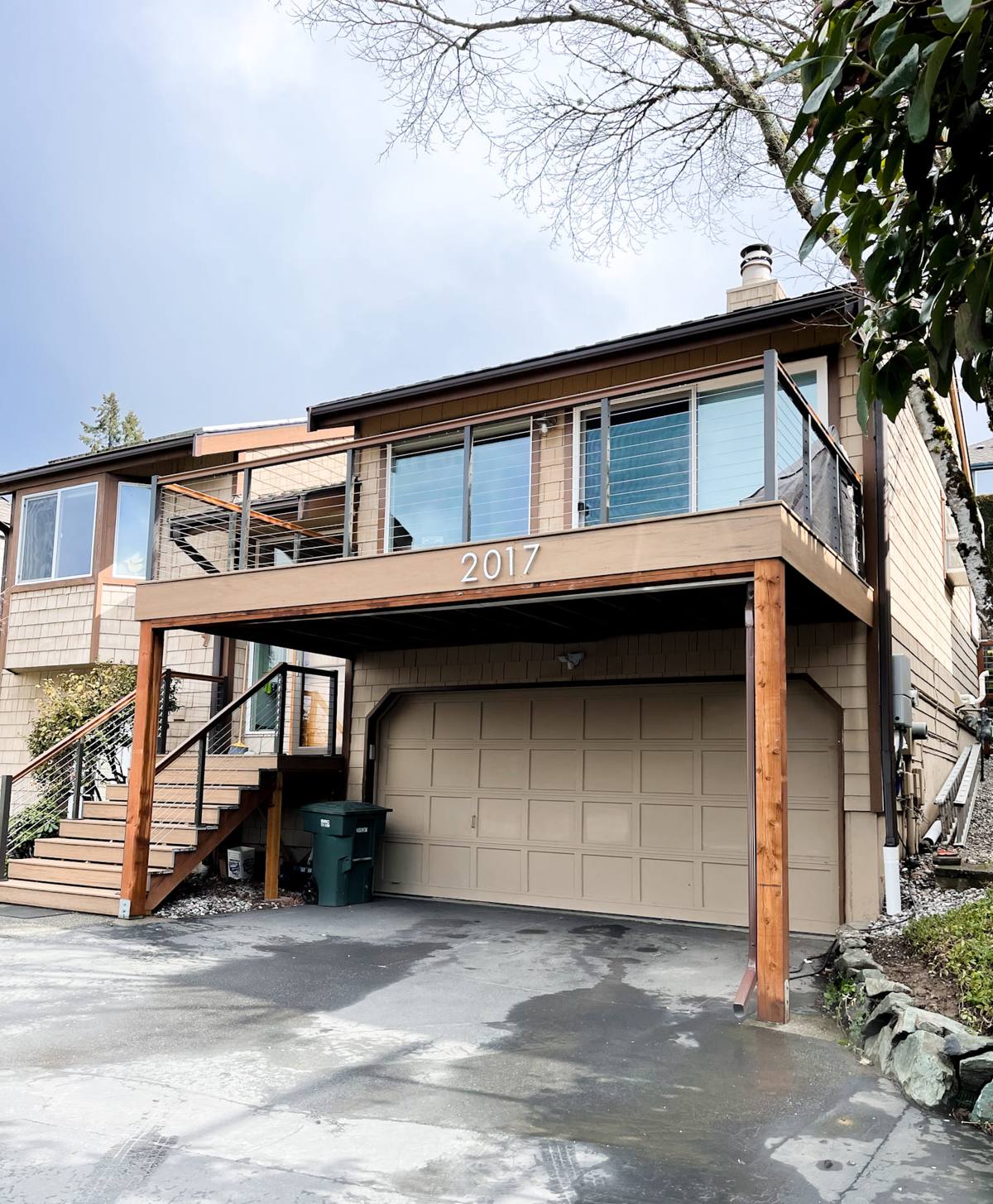
Railings and guardrails aren't just a design choice — they're a code-driven safety component, and in a coastal wind zone the attachment method matters as much as the material. Aluminum and cable railing systems tend to hold up well against salt air with minimal upkeep; painted wood railings look great but need more frequent maintenance to keep salt and UV from working through the finish.
Pinellas County and the Florida Building Code govern permitting for new decks and major deck rebuilds, and coastal jurisdictions like Belleair Beach often layer on additional review for structures near the water. Getting this wrong isn't just a paperwork problem — an unpermitted deck can complicate a home sale or an insurance claim down the road. We handle the permitting and inspection process as part of the job so the homeowner isn't the one chasing down approvals.
Our Process for a Belleair Beach Deck Project
Every project follows the same basic sequence, adjusted for the specific home and site:
- On-site assessment — we look at the house's structure, the ledger location, drainage, sun and wind exposure, and existing conditions before recommending anything.
- Design and material selection — layout, railing style, and decking material chosen around the homeowner's budget, maintenance preference, and how the space will actually be used.
- Permitting — drawings and applications submitted to the county/city, with any required engineering for structural or wind-load review.
- Framing and structural work — footings, posts, beams, and joists built to the engineered plan with corrosion-rated hardware throughout.
- Decking, railings, and finish work — boards, railings, stairs, and any lighting or fascia detailing installed and inspected.
- Final walkthrough — we go over the finished deck with the homeowner, including what maintenance it does and doesn't need.
Keeping a Belleair Beach Deck Looking Good for the Long Haul
The material choice determines how much upkeep a deck needs, but every deck on this island benefits from a basic maintenance routine. A little regular attention prevents most of the problems that shorten a deck's life here.
- Rinse salt residue off the decking surface and railings every few weeks, especially after windy or stormy stretches
- Sweep away leaves and debris from between boards so moisture doesn't sit trapped underneath
- Check fastener heads and railing connections once or twice a year for early signs of corrosion or looseness
- Reseal or oil wood decking on the manufacturer's recommended schedule — don't wait until it's already gray and dry
- Keep gutters and downspouts near the deck clear so runoff isn't dumping extra water onto framing or footings
- Inspect ledger flashing and any wall penetrations after major storms for signs of water intrusion
Why Hiring a Crew That Already Works in Belleair Beach Matters
A contractor who only occasionally works this close to the water tends to build to the same spec they'd use anywhere else — because that's what they know. A crew that regularly works Belleair Beach and the surrounding Pinellas County coastline already knows which fasteners actually hold up here, which decking products perform versus which ones fade and delaminate early, and what the local permitting process expects before a project starts. That experience shows up as fewer surprises during inspection, fewer callbacks for corroded hardware or loose railings, and a deck that's actually built for the wind and salt it will face rather than a generic set of blueprints.
If you're planning a new deck or replacing one that's showing its age, we're happy to walk the site with you, talk through material options honestly, and put together a straightforward, no-pressure estimate using the form below.