 Seminole Siding
 Redington sits on Pinellas County's barrier island strip, reached from Seminole by causeway across the Intracoastal, and that setting changes what a deck needs to survive compared to a build a few miles inland. Homes here take salt air off the Gulf, some of the most intense year-round UV exposure in the country, wind-driven rain during the wet season, and the real chance of hurricane-force wind loads for several months a year. A deck built to a generic, catalog spec can look fine on install day and still start failing at the fasteners or the framing underneath within a few years. This page covers what a custom deck actually needs to hold up in Redington, what a correct build involves, and why it matters that the crew doing the work already builds decks in this specific stretch of the county.
What Redington's Climate Actually Does to a Deck
Hurricane-Force Wind Loads
A deck on or near the barrier island doesn't get the buffer that an inland lot has. Framing, ledger attachment, and railing all have to be sized and fastened for wind loads that a deck built a few miles inland simply doesn't see as often, and Pinellas County's wind-borne debris and structural requirements reflect that. On an elevated deck tied to a piling-supported or raised home, the wind exposure is even more direct, which is exactly why the connection points — not just the visible surface — are where a deck earns or loses its durability.
Year-Round, Intense UV
Florida's sun angle and day length mean a deck surface here absorbs far more cumulative UV exposure per year than a deck in most of the country, and it takes that sun with no wall or roofline shading it the way the rest of the house is shaded. UV breaks down unstabilized plastics, cheaper finishes, and unprotected wood fibers faster than almost any other stress a deck faces, which is why board quality and cap construction matter more here than the color swatch on a sample chip.
Wind-Driven Rain
Straight-down rain is easy for almost any decking to shed. Rain pushed sideways by a 40, 50, or 60+ mph gust finds its way under boards, into ledger connections, and around railing posts in ways calm-weather rain never tests. Over a storm season or two, a deck with a marginal ledger flashing detail or under-sealed post base starts showing rot or corrosion at exactly those points, usually before the surface boards show anything at all.
Salt Air
Redington's location puts homes close to the Gulf, and airborne salt settles on every exposed surface continuously, not just during storms. It's a slow, cumulative process that goes after exposed metal — fasteners, brackets, railing hardware — long before it's visible as rust. A fastener that's quietly corroding loses holding strength well before it looks obviously bad, which is part of why fastener grade on a Redington deck isn't a place to save money.
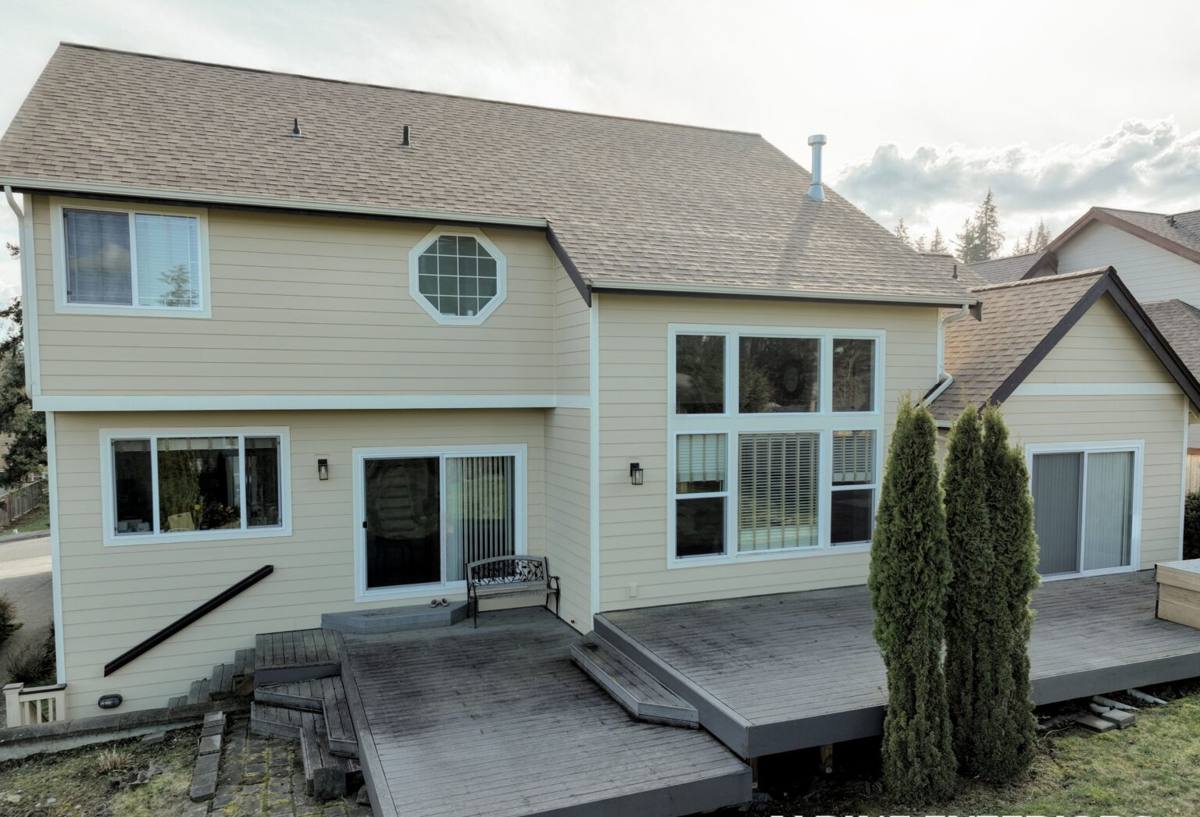
Deck Situations We Build For in Redington
- Elevated decks on piling-supported homes — common on barrier island lots, where the deck ties into a raised structure and carries its own wind and access considerations
- Pool decks — surfaces that need to handle constant sun, splash, and foot traffic without getting uncomfortably hot or slick
- Canal and waterfront decks — built close to brackish water and dock access, where moisture and salt exposure run higher than a typical lot
- Full replacements of aging wood decks — older pressure-treated decks that have gone gray, cupped, or soft at the framing after years of Gulf sun and salt
- Additions tied to renovations or Florida rooms — decks built to match an expanded living space rather than a standalone structure
What a Correct Custom Deck Build Involves Here
Substructure and Framing
The framing underneath is doing the structural work the whole deck depends on, and it's usually the first thing to fail if it's built with the wrong material or fastened incorrectly — long before the surface boards show a problem. On Redington lots that means framing rated for coastal ground contact and moisture exposure, sized and spaced to the load and span requirements of whatever decking material sits on top of it.
Fasteners and Hardware
We use stainless steel or coastal-grade coated fasteners throughout, not standard-grade hardware that starts corroding faster in salt air. That applies to structural connectors and railing hardware as much as the fasteners holding the deck boards themselves — it's an easy detail to skip and a hard one to fix once the deck is built.
Ledger Attachment and Flashing
Where a deck ties into the house is a common failure point in wind and wet conditions, and it's not a detail that forgives shortcuts on a barrier island lot. Proper ledger flashing keeps wind-driven rain from working its way into the wall assembly behind the connection, and the attachment itself has to be engineered for the wind load the deck will actually see, not a generic minimum.
Railing and Code Compliance
Railing height, baluster spacing, and post attachment all follow Florida Building Code requirements, and on an elevated or waterfront deck those requirements get stricter, not looser. We build to code as a floor, not a target, and we're upfront if a homeowner's request would fall short of what an inspector is going to expect.
Decking Material Options for This Environment
The material on top gets the most attention, but it also has to be matched to what a Gulf-facing lot actually does to it over years, not just how it looks in a showroom.
| Material | Salt Air & UV Performance | Maintenance | Notes for Redington |
|---|---|---|---|
| Capped composite | Strong — protective cap resists moisture, staining, and UV fade | Occasional washing; no sealing or staining | Our standard recommendation for most coastal builds here |
| Cellular PVC | Excellent — no wood fiber to absorb moisture | Occasional washing; no sealing or staining | Worth considering for pool decks and full water exposure; higher upfront cost |
| Uncapped composite | Moderate — can absorb some moisture and fade faster | More frequent cleaning to manage staining | Generally not what we recommend this close to the Gulf |
| Pressure-treated wood | Weakest against salt air over time — corrodes fasteners, absorbs moisture | Regular sealing or staining required | Lowest upfront cost, highest ongoing upkeep in this climate |
| Tropical hardwood | Good natural density, still needs finish upkeep against UV | Periodic oiling to prevent graying and checking | Distinct look, more maintenance commitment than composite or PVC |
Capped vs. Uncapped Composite
Capped composite boards wrap a wood-plastic composite core in a protective plastic shell, which is what actually resists moisture absorption and UV fade in a humid, salt-heavy environment. Uncapped composite is the older version of the product, with the wood-plastic blend exposed on all sides — it can absorb moisture and fade or stain faster here than it would in a milder climate. We standardize on capped composite for Redington installs for that reason, though PVC is worth a real conversation for decks that see constant water exposure, like pool surrounds.
Our Process, Start to Finish
- Site visit — we look at the existing deck or bare site, drainage and grade, sun exposure through the day, and how close the lot sits to the water
- Honest material and design recommendation — based on how the deck will actually be used and the specific exposure of that lot, not a default pitch
- Permitting — we handle the permit process for Pinellas County and Redington's requirements, including any additional review that applies to elevated or waterfront decks
- Substructure build — framing, ledger attachment, and fastening detailed for the site's actual wind and moisture exposure
- Decking, railing, and finish work — surface material installed with correct gapping and fastening, railing built to code, trim finished to match the home
- Final walkthrough — we explain what the specific material you chose actually needs for upkeep, which is usually minimal but not zero
Quick Checklist Before You Hire
- Confirm the framing and structural connectors are rated for coastal ground contact and moisture exposure
- Ask what fastener grade is being used — stainless or coastal-coated, not standard hardware
- Get the ledger flashing and attachment plan explained, especially on an elevated deck
- Ask whether the decking material is capped composite, PVC, or something else, and why that fits your lot
- Confirm railing height and baluster spacing meet current Florida Building Code requirements
- Make sure permitting is included and handled by the contractor, not left for you to sort out
Why Hiring a Crew That Already Works Redington Matters
A crew that mostly builds decks well inland can still do competent work, but a barrier island job has variables that don't come up as often elsewhere — wind load tied to open-water exposure, permitting that can involve extra review for elevated or waterfront structures, salt exposure that never lets up, and site access that's often tighter than a typical inland lot. Working this stretch of the coast regularly means we're not guessing at those requirements or learning them on your project. We know what fastener grade actually holds up here, how a ledger connection needs to be flashed on a piling-supported home, and what Pinellas County's permitting process expects for a deck this close to the water.
That familiarity also shows up in the smaller calls — knowing which composite lines have actually held up to years of Gulf sun rather than a few months, and being straightforward with you about what your deck genuinely needs versus what's just an upsell.
Ready When You Are
Whether you're replacing a wood deck that's gone gray and soft, building new on a piling-supported home, or adding a pool deck that can handle the sun and salt, it's worth having someone look at the actual site before you start pricing materials. We offer free, no-pressure estimates for custom deck projects in Redington and the surrounding Seminole area — use the form below to get a time on the schedule.